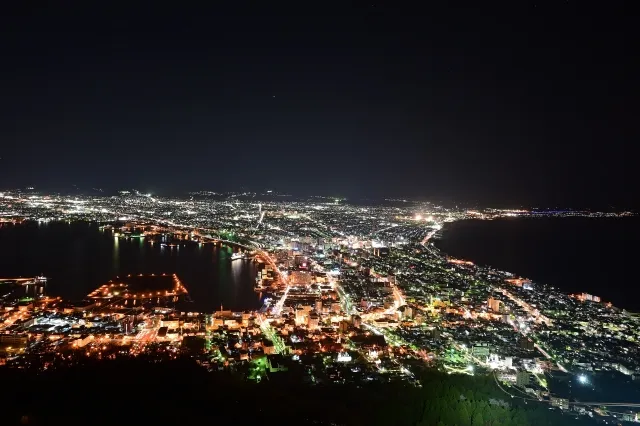
Understanding This Night View: The Hourglass Silhouette
The night view from Mount Hakodate is world-renowned for its unique hourglass shape. The vibrant city lights are squeezed between two dark bodies of water—Tsugaru Strait and Hakodate Bay—creating an unmistakable coastal contrast.
【Definition of Japan’s Top 3 Night Views in This Guide】
This feature focuses on the classic “Three Great Night Views of Japan”—Mount Hakodate (Hakodate), Maya Kikuseidai (Kobe), and Mount Inasa (Nagasaki)—widely recognized for their dramatic topography and light contrast. (Note: Alternative rankings like “Japan’s New Top 3 Night Views” also exist in modern tourism).
Access Design: Calculating Backward from Sunset
To witness Mount Hakodate at its absolute peak, plan your trip by calculating backward from sunset time rather than relying on fixed train schedules.
- Recommended Observation Deck Arrival: 90 minutes before sunset
- Recommended Arrival at Shin-Hakodate-Hokuto Station: 160 minutes before sunset (40 mins local transfer + 30 mins ropeway/bus buffer)
If traveling from Tokyo or Sendai via the Hokkaido Shinkansen, select a Hayabusa train that arrives at Shin-Hakodate-Hokuto roughly 2.5 to 3 hours before sunset.
【Shinkansen Travel Guides】
Before|Waiting: Embracing the Wind and Pre-Sunset Atmosphere
Arriving 90 minutes before sunset allows you to secure a prime viewing position at the outdoor deck or near the indoor glass lounge before evening crowds gather.
Pre-Sunset Checkpoints
- Temperature & Wind: Mount Hakodate summit is 3°C to 5°C colder than the city center and experiences strong ocean winds. Bring warm layers even in summer, and heavy winter gear from autumn to spring.
- Moonlight & Atmospheric Factors: A full moon illuminates the sea with silver reflections, whereas a new moon creates a razor-sharp contrast between city lights and jet-black waters.
During|Viewing: Three Phases of Light Transformation
Over a 90-minute period, the landscape undergoes a magical transformation:
- Pre-Sunset (30 mins before sunset): The sun dips into the Tsugaru Strait, painting the sky in crimson and gold while city silhouettes emerge.
- Blue Hour (10–45 mins after sunset): 【PRIME VIEWING WINDOW】 The sky turns deep indigo. As streetlights flicker on, the balance between natural twilight and artificial light reaches 100% harmony.
- Deep Night (50+ mins after sunset): The sky turns pitch black, making the glowing urban arch stand out brilliantly against the dark twin bays.
Insight|Why This Moment Touches the Soul
Mount Hakodate’s magic lies in visual reduction and luminous equilibrium:
- Natural Light Framing: Unlike flat urban sprawling lights, Hakodate’s dark twin seas frame the city, naturally drawing the human eye into the dense central corridor of light.
- The Science of Blue Hour: Human eyes struggle with harsh contrast in total darkness. During the Blue Hour, the intensity of remaining skylight matches the brightness of city lamps, providing maximum depth, color richness, and 3D perception.
After|Lingering: Descending to the Historic Bay Area
Once the Blue Hour transitions into full night, avoid peak ropeway descent lines by relaxing at the summit lounge before heading down.
- After-View Stroll: Take a gentle walk down Motomachi’s illuminated slope streets (such as Hachiman-zaka) toward the Kanemori Red Brick Warehouse district.
- Evening Recommendations: Warm up at local craft beer pubs or enjoy Hakodate’s famous Shio (salt) Ramen while reflecting on the city lights you just viewed from above.