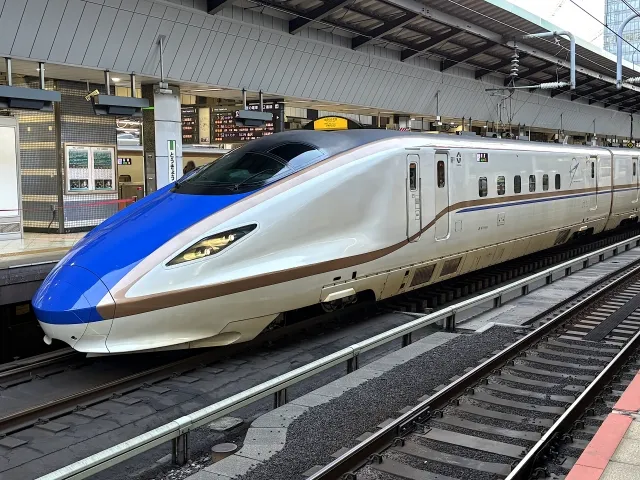
Complete Scenery, Stations & Route Guide
Tokyo to Tsuruga (Approx. 600km)
A scenic route revealing the Northern Alps and Sea of Japan
1. About the Hokuriku Shinkansen
Connecting Tokyo directly to Tsuruga via Kanazawa
Serving as a vital artery to the Sea of Japan coast, the Hokuriku Shinkansen runs four unique trains: "Kagayaki", "Hakutaka", "Tsurugi", and "Asama". Beyond business travel, it is profoundly popular as a scenic tourism route offering breathtaking panoramas of the Northern Alps and Sea of Japan. As of March 2024, the line has officially extended down to Tsuruga.
| Specification | Details |
|---|---|
| Operating Distance | Approx. 600 km (Tokyo to Tsuruga) |
| Max Speed | 260 km/h (161 mph) |
| Year Opened | 1997 (Takasaki to Nagano opened ahead of the Nagano Olympics) |
| Train Services | Kagayaki, Hakutaka, Tsurugi, Asama |
| Kanazawa → Tsuruga Extension | Opened March 16, 2024 |
Comparing the Hokuriku Trains
| Train Name | Route | Characteristics |
|---|---|---|
| Kagayaki | Tokyo ↔ Kanazawa/Tsuruga | The fastest express train, stopping only at major stations. Entirely reserved seating. |
| Hakutaka | Tokyo ↔ Kanazawa/Tsuruga | Convenient standard service that stops at most stations. |
| Asama | Tokyo ↔ Nagano (some Karuizawa) | Focused service catering exclusively to Nagano and Karuizawa. |
| Tsurugi | Toyama/Kanazawa ↔ Tsuruga | Regional shuttle service connecting cities purely within the Hokuriku area. |
Shinkansen Station Stops
| Station Name | Kagayaki | Hakutaka | Asama |
|---|---|---|---|
| Tokyo | ● | ● | ● |
| Ueno | - | Some | ● |
| Omiya | ● | ● | ● |
| Kumagaya | - | - | Some |
| Honjo-Waseda | - | - | Some |
| Takasaki | - | ● | ● |
| Annaka-Haruna | - | Some | Some |
| Karuizawa | - | ● | ● |
| Sakudaira | - | Some | ● |
| Ueda | - | ● | ● |
| Nagano | ● | ● | ● |
| Iiyama | - | Some | - |
| Joetsu-Myoko | - | ● | - |
| Itoigawa | - | Some | - |
| Kurobe-Unazukionsen | - | Some | - |
| Toyama | ● | ● | - |
| Shin-Takaoka | - | Some | - |
| Kanazawa | ● | ● | - |
| Komatsu | - | Some | - |
| Kagaonsen | - | Some | - |
| Awaraonsen | - | Some | - |
| Fukui | Some | ● | - |
| Echizen-Takefu | - | Some | - |
| Tsuruga | ● | ● | - |
2. Scenic Highlights
The Tateyama Mountain Range (Seat A • Outbound)
The Hokuriku Shinkansen's utmost jewel. Emerging after Nagano and approaching Toyama Station, the Tateyama Mountain Range crests fiercely on your right-hand side (left-side of the train, Seat A). The wall of 3000-meter alpine peaks commands an entirely different kind of majesty than Mt. Fuji on the Tokaido line.
The Sea of Japan (Seat E • Outbound)
The segment between Joetsu-Myoko and Itoigawa is intensely saturated with tunnels. However, there is an instantaneous flash where the Sea of Japan boldly reveals itself. Operating at 260 km/h, the moment lasts merely a few seconds, requiring keen attention.
Mt. Asama (Seat A • Outbound)
During the traverse from Takasaki to Karuizawa, Seat A (Left side outbound) grants you unparalleled access to the tremendous foothills of Mt. Asama. As you pop through tunnels prior to arriving in Karuizawa, its imposing cratered profile dominates the skyline.
New Scenery on the Tsuruga Extension
The newly opened section established in March 2024 offers fresh discoveries. The colossal "Kaga Daikannon" near Kagaonsen, and the expansive viaduct views prior to halting at Tsuruga are deeply rewarding sights exclusive to this fresh geography.
3. Station Guide
Tokyo / Omiya
Tokyo operates as a shared gateway for the Joetsu, Tohoku, and Hokuriku routes. Omiya functions seamlessly for travelers commuting from the Saitama prefecture region, with the express "Kagayaki" stopping efficiently.
Nagano
The former terminus, forged specifically for the 1998 Nagano Winter Olympics. A beloved jumping-off spot for Zenko-ji Temple and Togakushi tourism. With the Kagayaki stopping here, Tokyo remains just a stone's toss away.
Toyama
The ultimate doorway to the Northern Alps and the starting line of the Tateyama Kurobe Alpine Route. All express Kagayaki trains halt here. Transferring neatly to the local Toyama Light Rail tram system is exceptionally popular.
Kanazawa
The illustrious castle town of the Kaga Million Koku domain. With Kenrokuen Garden, Kanazawa Castle, and the ancient Higashi Chaya district, it remains an immovable titan of Hokuriku tourism even after the Tsuruga extension.
Fukui / Tsuruga
The fresh frontiers added in 2024. Fukui acts as the prime gateway to exploring the internationally renowned Fukui Prefectural Dinosaur Museum. Tsuruga pulses with deep marine history and cuisine, serving as the critical juncture for transferring onto standard express trains bound for Osaka (Thunderbird) and Nagoya (Shirasagi).
4. Popular Routes
A summary of the most frequented legs of the Hokuriku Shinkansen, including basic travel durations and standard unreserved pricing.
| Route Segment | Time (Via Kagayaki) | Est. Unreserved Fare |
|---|---|---|
| Tokyo → Nagano | Approx. 1h 20m | From ¥6,020 |
| Tokyo → Toyama | Approx. 2h 8m | From ¥9,690 |
| Tokyo → Kanazawa | Approx. 2h 28m | From ¥13,800 |
| Tokyo → Fukui | Approx. 2h 51m | From ¥14,210 |
| Tokyo → Tsuruga | Approx. 3h 8m | From ¥15,130 |
5. Travel Tips
The Ultimate Seat Summary
| Desired Scenery | Direction of Travel | Target Seat |
|---|---|---|
| Tateyama Mtn. Range | Tokyo → Toyama | Seat A (Left Side) |
| Tateyama Mtn. Range | Toyama → Tokyo | Seat E (Right Side) |
| Sea of Japan | Tokyo → Itoigawa | Seat E (Right Side) |
| Mt. Asama | Tokyo → Karuizawa | Seat A (Left Side) |
Beware of Tunnel Contrast
Hokuriku entails heavily tunneled terrain. When moving violently between pitch blackness and bright snowscapes, particularly near Itoigawa, your camera will struggle to adjust focus. Emphasize utilizing an AE (Auto-Exposure) Lock function on your smartphone to retain stable brightness.
6. FAQ
- Q. Should I book the Kagayaki or Hakutaka?
- If your outright destination is Kanazawa, Toyama, or Tsuruga, the Kagayaki slices massive chunks of travel time off you journey. Choose the Hakutaka strictly if you wish to disembark at intermediate stops like Karuizawa, Nagano, or Joetsu-Myoko.
- Q. Does the Hokuriku Shinkansen feature a Green Car?
- Yes. Both the W7 and E7 class trains link a standard Green Car (Car 8), alongside the outrageously luxurious highest-tier "Gran Class" (Car 12).
- Q. Can I see the Tateyama Mountains in Winter?
- While absolutely gorgeous cloaked entirely in frost, winter runs a high risk of overcast blizzard skies blocking the summits. Early spring (March - April) yields the mathematically highest chance for clear, striking morning skies.
- Q. How do I travel to Osaka/Kyoto after reaching Tsuruga?
- At Tsuruga station, you physically transfer from the Shinkansen platform over to the Limited Express platform running the "Thunderbird" (Bound for Kyoto/Osaka) or "Shirasagi" (Bound for Nagoya). Provide yourself abundant time to execute this platform switch.