Complete Guide to Traveling with Pets on the Shinkansen
Planning to travel with your dog or cat on Japan's Shinkansen? Learn all about JR's pet carry-on rules, how to pay the ¥290 fee at the station, and how to choose the best seats (last row, first row, and aisle seats) for a comfortable journey.
JR rules, ¥290 fee, crate sizes, best seats, and stress-free travel tips
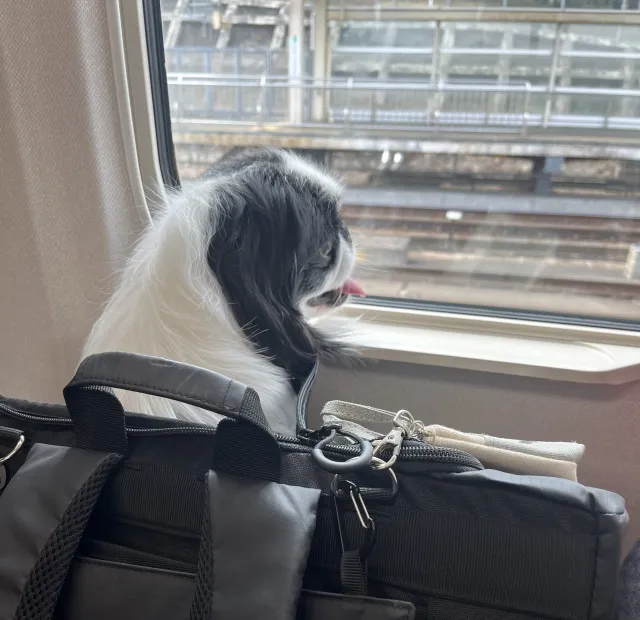
① Essential JR Pet Rules & Fee (¥290)
Traveling with small pets (dogs, cats, birds) on Japan’s bullet trains (Shinkansen operated by JR Group) is allowed under specific conditions.
Here is a quick overview of the official JR pet rules you need to know before heading to the station:
Key Summary of JR Pet Rules
- Carry-on Fee: ¥290 per container (Paid as “Paid Ordinary Baggage” / 有料普通手荷物)
- How to Pay: Buy a pet baggage tag at the station ticket gate or ticket office on travel day and attach it to your carrier.
- Size Limit: Total dimensions (Length + Width + Height) up to 120 cm
- Weight Limit: Combined weight of pet + carrier up to 10 kg
- Enclosure: The pet must be completely enclosed in a dedicated carrier/crate (heads and paws cannot stick out). Pet strollers are allowed only if the carrier detaches from the frame.
How to Purchase the ¥290 Pet Ticket at the Station
- Arrive at the station a bit early: Head to the manned ticket gate (改札口) or Midori-no-Madoguchi ticket office.
- Request a pet baggage ticket: Inform the staff: “Pet-to issho ni norimasu” (I am riding with a pet) or ask for a pet baggage tag (Teanimotsu-kippu).
- Attach the tag: Tie the issued paper tag securely onto your pet carrier bag or crate handle.
② Which Seat to Book? (Why This Seat Logic)
To ensure a smooth trip for both you and your pet, seat selection is essential. You want a seat with adequate space for the carrier and easy access to the vestibule/deck in case your pet makes noise.
3 Golden Rules for Selecting Your Seat
🐾 3 Golden Rules for Pet Travel Seat Selection
- 【1st Choice】Last Row Seats in Any Car (With Extra Baggage Area)
- Placement: Behind the backrest of your seat
- Why: Keeps your legroom clear while keeping your pet calm in a quiet, dark spot.
- 【2nd Choice】First Row Seats in Any Car (Row 1 Seats A-E)
- Placement: In the spacious wall-front footwell
- Why: Ample distance between your seat and the front wall allows you to place the carrier comfortably at your feet.
- 【Key Position Rule】Always Choose Aisle Seats (Seats C or D)
- Why: If your pet makes noise or needs a break, you can step out to the deck or vestibule in seconds without climbing over neighboring passengers.
Recommended Seat Comparison Table
| Priority | Recommended Seat | Seat Numbers | Key Benefits & Reasons |
|---|---|---|---|
| Top Pick | Last Row of Car | Last row of any car (A-E) | Carrier fits behind seat. Keeps your legroom clear and provides a quiet, dark spot for pets to rest. |
| 2nd Pick | First Row of Car | Row 1 of any car (A-E) | Generous wall-front space. Easy to place the carrier in front of your feet comfortably. |
| Strongly Advised | Aisle Seats | Seat C (3-seat side) / Seat D (2-seat side) | Instant deck access. Easily step out to the vestibule area without climbing over neighboring passengers. |
③ Line & Car Specific Features
Different Shinkansen train models offer distinct features that make traveling with pets easier.
Tokaido & Sanyo Shinkansen (N700S / N700A)
- Recommended Area: Car 11
- Why: Car 11 features a Multi-Purpose Room (多目的室), accessible restrooms, and wider vestibule areas. This gives you extra room to calm your pet if needed.
Hokuriku, Joetsu, Tohoku & Hokkaido Shinkansen (E5 / E7 / W7 series)
- Recommended Area: Train Vestibules (Decks)
- Why: Modern JR East and JR Hokkaido bullet trains have spacious, sound-insulated deck areas between cars, making them ideal places to step out quietly if your pet whimpers.
④ Pre-Departure & In-Train Checklist
Use this checklist to prepare your pet for a safe and comfortable Shinkansen ride:
Preparation Checklist
- Crate Training: Get your pet used to staying inside the carrier before travel day so it feels like a safe space.
- Feeding Schedule: Feed your pet 1 to 2 hours before departure to prevent motion sickness.
- Bathroom Break: Walk your pet and let them use the bathroom right before entering the station gates.
- Pet Ticket (¥290): Purchase the baggage tag at the station gate before boarding.
Useful In-Cabin Supplies
- Odor-Proof Disposal Bags: For disposing of used pet pads or wipes cleanly.
- Pet Pads / Diapers: Line the inside of the carrier with absorbent pads.
- Familiar Blanket/Towel: Placing a towel with your home scent over the carrier reduces anxiety.
- No-Spill Water Bottle: For quick hydration during the trip.