Nozomi vs Hikari: which should you take?
Compare the departure, stops and ticket conditions for your trip. Hikari is covered by the standard Japan Rail Pass; Nozomi requires an additional pass-holder ticket.
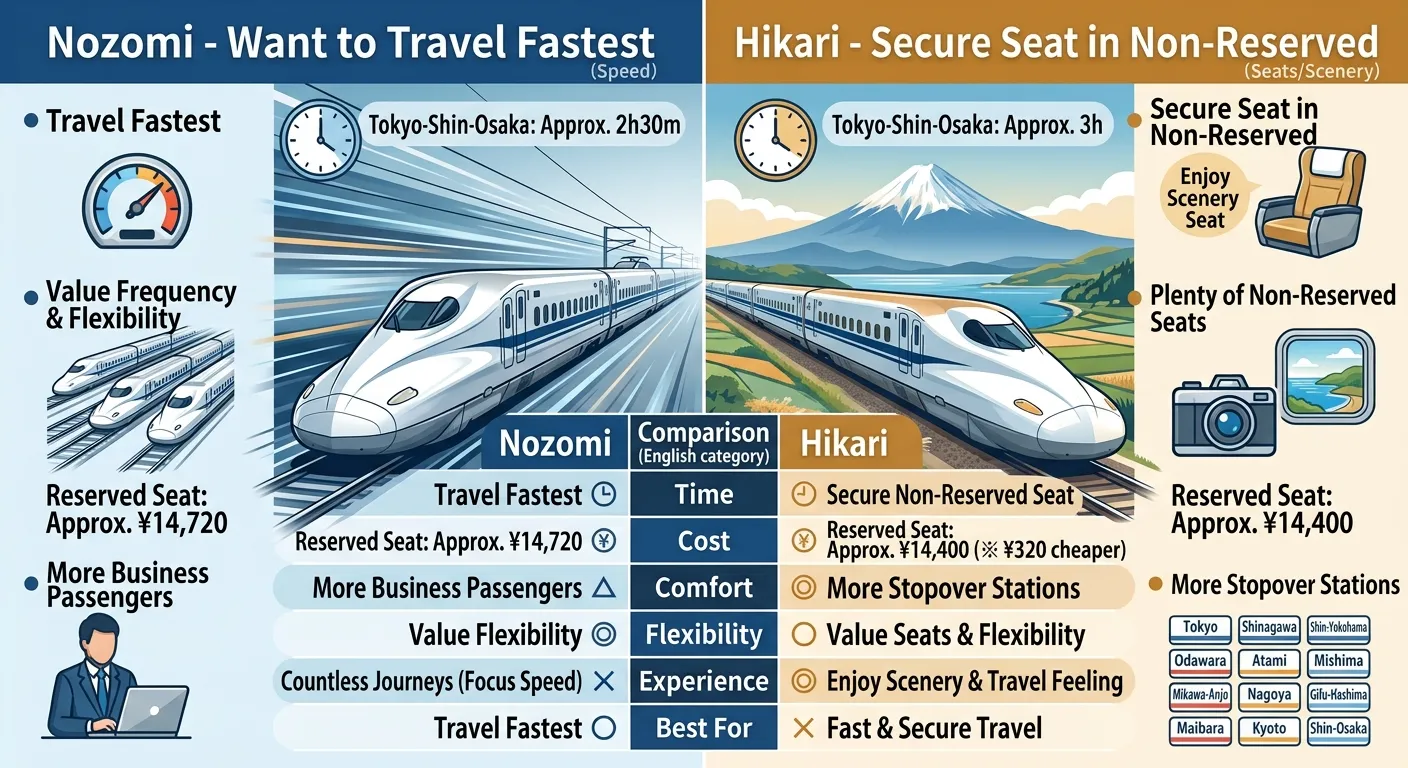
Quick answer
For a Japan Rail Pass trip without an additional Nozomi ticket, choose Hikari. For other journeys, compare actual departures and arrival times. Your destination’s stopping pattern matters as much as the train name.
| What to compare | Nozomi | Hikari |
|---|---|---|
| Stops | Fewer intermediate stops | More intermediate stops; pattern varies by service |
| Travel time | Generally faster on the same route | Check the actual departure and arrival |
| Standard Japan Rail Pass | Additional pass-holder ticket required before boarding | Covered, subject to pass conditions |
| Seat reservation | Check the travel date; all seats are reserved during designated peak periods | Check your service’s seating allocation |
| Mt. Fuji side, ordinary car | Seat E in either direction | Seat E in either direction |
Japan Rail Pass: the important difference
The official Japan Rail Pass guide explains the additional ticket required to use Nozomi. Its listed Tokyo–Kyoto and Tokyo–Shin-Osaka price is ¥4,960. Check the current conditions and section before purchasing.
Non-reserved seats and peak dates
Do not rely on an old carriage count. Check your train’s current seating allocation and JR Central’s peak-period Nozomi notice. More non-reserved cars do not guarantee an available seat.
Which side has the Mt. Fuji view?
Ordinary-car Seat E is the Fuji side in both directions. In a Green Car, check Seat D. Direction changes left and right, rather than the seat letter. Weather and visibility still matter. See JR Central Tours’ seat guide and our Fuji seat guide.